Transport
T-money vs Climate Card vs WOWPASS: Which Korea Travel Card Should You Choose?
Choose standard Tmoney for simple pay-as-you-go transit, a Climate Card Short-Term Pass for repeated eligible travel within Seoul, or WOWPASS when prepaid store payment and currency loading matter as much as transport.
Official-source checked Checked
The listed official sources were checked for this version of the guide.
Verification limit: This guide was checked against current official Tmoney, Seoul Metropolitan Government, Korea Tourism Organization, and WOWPASS pages on August 12, 2026. No card was purchased, loaded, tapped, refunded, linked to an app, used at a merchant, or tested with a foreign card or phone. Recheck prices, service boundaries, machine availability, payment support, and refund rules on the official pages before acting.
- Next review
- Change rate
- Reviewed every 30 days
- Sources checked
- 12
Answer in 30 seconds
These cards do different jobs, so there is no universal “best” card.
- Start with a standard Tmoney card if you are like most visitors who need uncomplicated pay-as-you-go public transport across Korea and can load it with Korean-won cash. It is the lowest-complexity default, not a universal winner.
- Choose a Climate Card Short-Term Pass when most of your journeys fall inside its current Seoul service range and the pass price is lower than your expected eligible pay-as-you-go fares. Its 1-, 2-, 3-, 5-, and 7-day periods begin on the day of loading, not at first tap and not as rolling 24-hour periods.
- Choose WOWPASS when you want a tourist prepaid card for ordinary store payments and currency loading as well as a Tmoney transit function. The WOWPASS payment balance and Tmoney transportation balance are separate and must be managed separately.
- Carry a fallback if you choose Climate Card. It does not cover every airport, regional, intercity, or non-Seoul journey. A standard Tmoney card, the separately loaded Tmoney function inside WOWPASS, or another accepted payment method can cover out-of-range travel.
Traveler compatibility
- Korean phone number
- Not required
- Foreign-issued card
- Partially supported
- Korean ID
- Not required
- English support
- Partial English
First, separate the three jobs
The cards overlap, but they are not direct substitutes.
Swipe or scroll to see all columns.
| Job | Standard Tmoney | Climate Card Short-Term Pass | WOWPASS |
|---|---|---|---|
| Basic transport model | Stored-value, pay per eligible trip | Unlimited eligible transit for a selected short period | Stored-value Tmoney transit function inside a tourist prepaid payment card |
| Main geographic fit | Nationwide where Tmoney is accepted | Current Climate Card service range centered on Seoul | Nationwide Tmoney acceptance for transit; separate WOWPASS merchant network for payments |
| Ordinary store payment | Some Tmoney-affiliated merchants | Not its purpose | Core purpose: prepaid local card payment at supported offline merchants |
| Currency loading or tourist payment wallet | No | No | Yes, through the operator’s supported kiosk and mobile routes |
| Balance structure | One Tmoney balance | A selected time pass | Two separate balances: WOWPASS payment and Tmoney transport |
| Strongest reason to choose | Simplicity and broad transport reach | Repeated eligible Seoul travel during a defined period | Combining tourist payment tools with a Tmoney transit function |
| Main boundary | Standard loading is Korean-won cash on the official foreigner guide | Route coverage, immediate activation, and excluded services | Passport/app/kiosk steps and separate transport funding |
Do not compare only the price printed on the card. Compare the full task: where you will travel, how often, how you can load money, whether you need store payment, and what happens if the chosen card fails.
Choose in five questions
1. Will most of your transport be inside the current Climate Card range?
If no, start with Tmoney or WOWPASS’s Tmoney function. The Climate Card covers Seoul-based subway lines, specified partial extensions, and Seoul-licensed city and town buses, but it excludes the Sinbundang Line, subway sections outside the service range, intercity and airport buses, and non-Seoul-licensed buses.
The range is not a simple circle around Seoul. A station can have a one-way or disembark-only exception. For example, the current official page says a passenger may disembark at Incheon Airport Terminals 1 and 2 after boarding within the covered range, but cannot board at either airport terminal with the Climate Card. Check every unusual endpoint on the official Climate Card service-range page.
2. Are you making enough eligible journeys for a pass to beat pay-as-you-go?
Do not multiply the number of taps by a base fare. A bus-to-subway transfer can be one discounted journey rather than two full fares, while distance surcharges can change another journey.
Use this worksheet:
- List each planned origin and destination.
- Mark whether the full journey is inside the current Climate Card range.
- Estimate the current pay-as-you-go fare for each journey, including transfers and distance.
- Add only the eligible journeys that fall inside the pass period.
- For a first physical Climate Card purchase, compare that total with the pass price plus the separate KRW 3,000 card cost.
- Keep a margin for changed plans. Do not buy the pass if it saves money only under a perfect itinerary you are unlikely to follow.
3. Do you need a tourist payment wallet as well as transit?
If you want to load supported foreign currency or an international card into a prepaid local payment balance, track store purchases in an app, or pause the payment card after loss, compare WOWPASS. Its transport function is still Tmoney, and the transport balance is separate from the WOWPASS payment balance.
If you only need buses and subways, WOWPASS’s extra issuance, passport, app, and kiosk workflow may add steps you do not need.
4. Can you load Korean-won cash?
The current official Tmoney foreigner guide instructs users to present the card and Korean-won cash at a Tmoney sales location. The Korea Tourism Organization’s current 2026 transport guide also labels standard Tmoney purchase and top-up as cash only for foreign visitors.
Climate Card short-term passes are different. Seoul’s March 2026 announcement says international credit and debit cards are accepted at 440 new transit-card machines across 273 stations on Lines 1–8, with an average service fee of approximately 3.7%. Card acceptance can still fail, and the checkout total can include issuer or network costs, so keep another supported card or cash.
WOWPASS supports the operator’s listed foreign-currency cash, international-card, and e-wallet loading routes for the WOWPASS payment balance. Do not assume that loading this balance also funds its Tmoney transit balance.
5. What is your fallback if the card does not work?
Choose the fallback before purchase:
- Climate Card out of range: use a separately funded standard Tmoney card, WOWPASS Tmoney balance, or another accepted ticket/payment method.
- Tmoney balance too low: load Korean-won cash at an official sales or station location.
- WOWPASS payment or app problem: use a second bank card or cash; keep the Tmoney balance modest and separate.
- Machine rejects a foreign card: try another supported card or cash rather than asking an unofficial helper.
- Lost card: report or pause it through the operator’s documented process when available, but do not assume every separate stored balance can be recovered.
Option 1 — Standard Tmoney
Choose standard Tmoney when transport is the main task and you value a simple pay-as-you-go card.
The current official sources describe Tmoney as a reloadable prepaid transport card sold at convenience stores and subway locations. It can be used on public transport and at locations displaying the Tmoney logo. The general card itself currently costs about KRW 3,000–5,000, and the money loaded onto it is separate from that non-refundable card cost.
What it does well
- broad public-transport acceptance compared with a Seoul-only pass;
- no pass period to activate or itinerary to lock in;
- transfer discounts when the card is tapped correctly within the current rules;
- easy cash loading at official convenience-store and station locations; and
- no need to build a payment-wallet account for basic adult transport use.
What to check
- Standard top-up on the official foreigner route uses Korean-won cash.
- The Tmoney logo, not the card’s appearance, confirms an accepted transport or merchant location.
- Youth or child discounts require a separate date-of-birth registration step and proof of age.
- The card cost is not included in a balance refund, and refund locations, limits, and fees vary.
- A regional, intercity, airport, train, or merchant transaction should be checked individually instead of assuming the word “nationwide” guarantees every service.
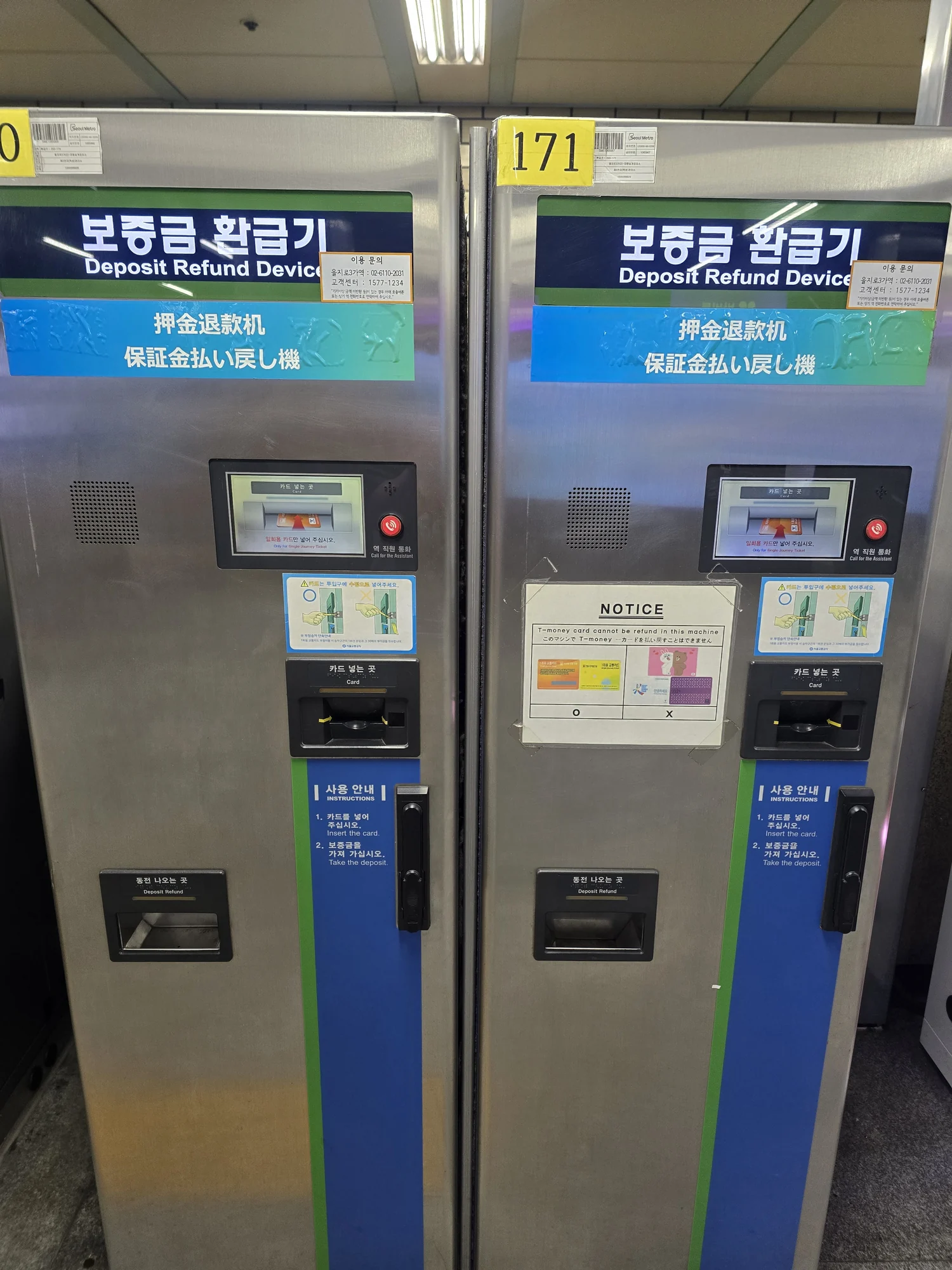
Do not confuse a single-journey ticket deposit-refund machine with a Tmoney balance-refund point. The current machines below explicitly say that T-money cannot be refunded there.
Option 2 — Climate Card Short-Term Pass
Choose a Climate Card Short-Term Pass when repeated travel inside the current eligible network is more important than nationwide flexibility.
The official Seoul page currently lists these short-term products:
Swipe or scroll to see all columns.
| Pass period | Load price | Important timing rule |
|---|---|---|
| 1 day | KRW 5,000 | Valid from loading day through the last eligible service that day; not 24 hours |
| 2 days | KRW 8,000 | Starts on the loading day |
| 3 days | KRW 10,000 | Starts on the loading day |
| 5 days | KRW 15,000 | Starts on the loading day |
| 7 days | KRW 20,000 | Starts on the loading day |
A physical card currently costs KRW 3,000 in addition to the pass. Short-term passes cannot be loaded in advance, and the official page says Ttareungi and Hangang Bus are not included in short-term passes.
What it does well
- removes per-ride fare calculation for eligible trips during the chosen period;
- can reduce cost for a dense Seoul itinerary after a real route-by-route comparison;
- lets foreign visitors buy and load a physical short-term pass with an international credit or debit card at supported new machines; and
- can be reused for another eligible short-term product after the active period, subject to current rules.
What to check before loading
- Confirm every important subway endpoint and bus operator.
- Confirm that the first loading date is the date you actually want the pass to begin.
- Add the KRW 3,000 physical card cost when comparing a first purchase.
- Keep a separate way to pay for airport buses, intercity travel, Sinbundang Line, out-of-range subway travel, and other exclusions.
- Tap both when boarding and leaving. Seoul warns that failing to tap out twice can suspend use for 24 hours from the last boarding.
The checked official Seoul and government travel pages conflict on the exact 2026 transition dates for the 30-day Climate Card. This Guide therefore excludes the 30-day product from prices and deadline comparisons. It compares only the short-term 1-, 2-, 3-, 5-, and 7-day products, not Climate Card Plus, Mpass, or any resident discount. Reopen the live Seoul policy page if a longer product matters to you.
Option 3 — WOWPASS
Choose WOWPASS when payment and currency handling are part of the problem you want one physical card to solve.
The operator describes WOWPASS as a tourist prepaid payment card that can be loaded through supported foreign-currency cash, international-card, and e-wallet routes. The same physical card contains a Tmoney transportation function.
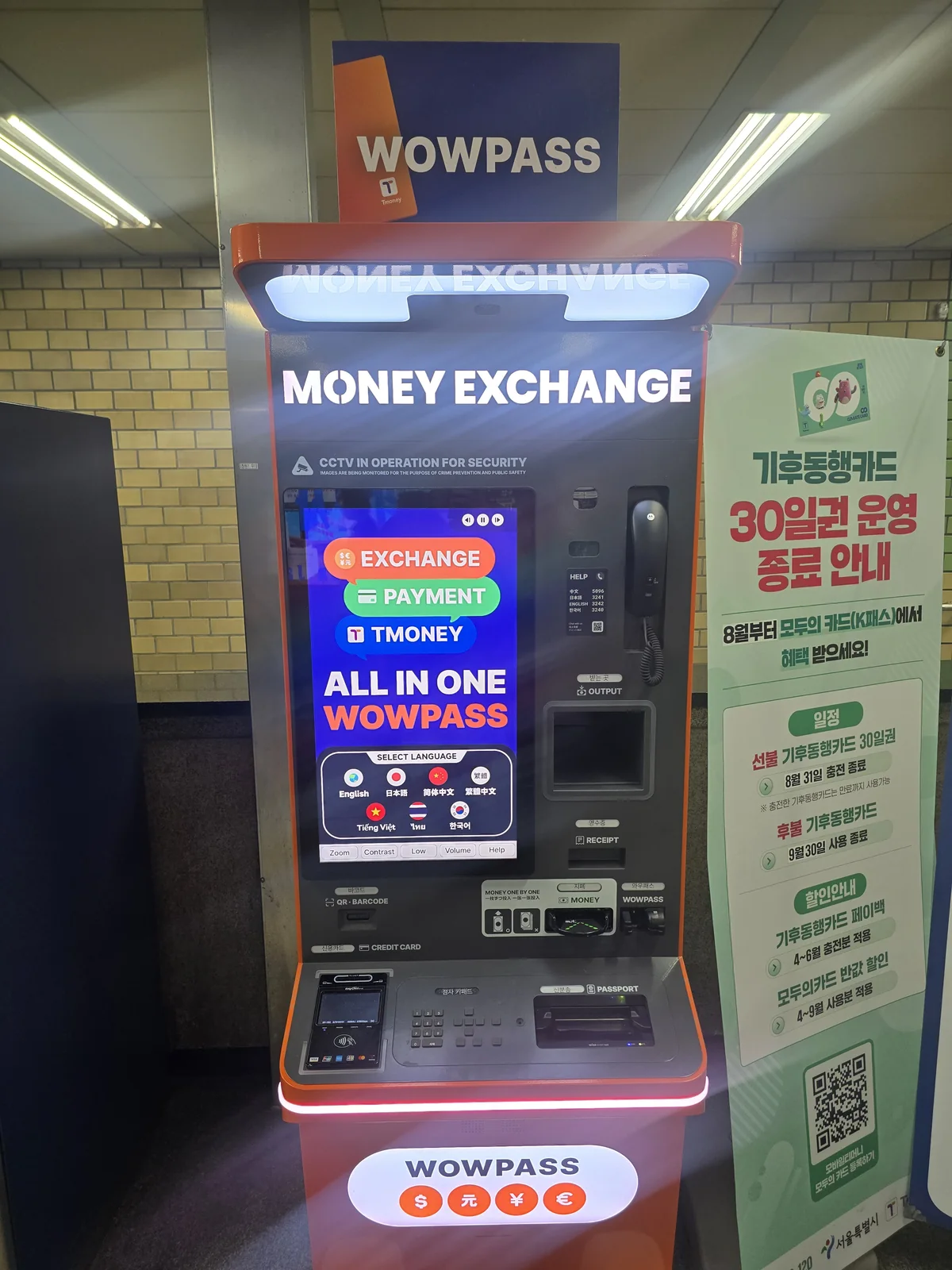
The most important operational fact is easy to miss: the WOWPASS payment balance and Tmoney transportation balance are separate. At an ordinary merchant you insert the card and spend from the WOWPASS balance. On a bus or subway you tap the card and spend from the separately loaded Tmoney balance.
What it does well
- prepaid local card payment at supported offline merchants that accept domestic credit or debit cards;
- supported foreign-currency exchange and payment-balance loading routes;
- a Tmoney transport function without carrying a separate standard Tmoney card;
- app-based payment history and balance management; and
- operator-documented pause and replacement tools for the registered payment card.
What to check
- The Korea Tourism Organization says a passport is required to purchase the card.
- The operator’s current product page shows different machine and pre-booked issuance prices; promotions and pickup routes can change.
- The Tmoney transport balance must be loaded separately from the WOWPASS payment balance.
- The checked official WOWPASS pages differ on mobile Tmoney loading: the current product page advertises app top-up, while the Orange Square FAQ documents Korean-won cash at convenience stores or blue Tmoney kiosks and app balance checking. Treat the exact NFC phone, card-network, and app path as Unknown — recheck in app, and keep cash as the fallback.
- A supported international network does not guarantee that every issuing bank, country, authentication step, or wallet will succeed.
- Do not assume that pausing the WOWPASS payment card also recovers or protects every won stored in the separate Tmoney function; the checked public pages did not establish that outcome.
- Keep a second payment method for merchants, deposits, online transactions, and any category the prepaid card does not support.
When two cards make sense
One card is simpler, but two different functions can justify two balances.
Climate Card plus standard Tmoney
This combination can work for a dense Seoul pass period plus a few out-of-range or regional trips. Load only a modest fallback amount onto Tmoney. The tradeoff is a second physical card, a second balance, and another non-refundable card cost.
Climate Card plus WOWPASS
This combination can work when the Climate Card handles eligible Seoul transit while WOWPASS handles prepaid store payment and keeps a separately loaded Tmoney fallback for excluded travel. It also creates three things to track: the Climate pass, WOWPASS payment balance, and WOWPASS Tmoney balance.
WOWPASS without a separate standard Tmoney card
If the integrated Tmoney function works for your itinerary and you keep it funded separately, a second standard Tmoney card is usually unnecessary. A separate card may still be useful for a companion, a child or youth fare registration, or a deliberate backup—but do not buy one merely because the WOWPASS payment balance appears full.
Purchase and loading checklist
- I listed the cities, airports, and major endpoints in my itinerary.
- I checked the Climate Card range for every non-obvious Seoul journey.
- I compared expected eligible pay-as-you-go fares with the pass plus first-card cost.
- I know the exact day a short-term pass will start.
- I know whether my loading path needs Korean-won cash, an international card, a passport, a kiosk, or an app.
- If using WOWPASS, I understand that merchant and transport balances are separate.
- I have a second accepted payment method and enough cash for one recovery step.
- I will keep each stored balance modest until the first real transaction succeeds.
Common failures and safest alternatives
Swipe or scroll to see all columns.
| Problem | Likely cause | Safest next action |
|---|---|---|
| Climate Card does not open the gate | The station or direction is outside the service range, the period expired, the card was not loaded, or a tap-out penalty applies | Ask station staff to check the card and pay the required fare through an official channel; use the backup payment method for that journey. |
| Climate Card was loaded too early | Short-term validity began on the loading date, not the planned first ride | Use it for the remaining valid days; do not expect the operator to shift the start date after activation. |
| Tmoney top-up rejects a foreign bank card | Standard foreigner top-up is documented as Korean-won cash | Use Korean-won cash at an official Tmoney sales or station location. |
| WOWPASS shows money but transit says insufficient balance | The visible WOWPASS payment balance is not the Tmoney balance | Check and load the separate Tmoney balance through an official supported route. |
| Merchant rejects WOWPASS | The transaction, terminal, merchant category, or balance is unsupported | Use a second bank card or cash; do not repeatedly force the transaction. |
| A foreign card fails at a Climate machine or WOWPASS route | Network, issuer, country, authentication, or machine support differs | Try another supported card or an official cash route where available. |
| Card is lost | Registration or balance-protection coverage may be incomplete, especially for a separate transit balance | Pause or report the card through the official operator process, then use the backup card or cash. Keep receipts and card identifiers if the operator requests them. |
| You cannot tell whether a bus is Seoul-licensed | Route branding or operator jurisdiction is unclear | Ask official transit staff or use pay-as-you-go Tmoney rather than assuming the Climate Card will work. |
| A refund is harder than expected | Registration, expiry, amount, account, location, or service-fee rules apply | Spend down the balance where practical or use the operator’s official refund desk; never sell the card or share account access with a stranger. |
Payment, phone, ID, and language boundaries
Korean phone number
A Korean phone number is not needed for the basic adult physical Tmoney purchase-and-cash-load route or for selecting and using a physical Climate Card short-term pass at an official machine. WOWPASS app registration and mobile authentication were not independently tested for this Guide. Use the physical card and official kiosk path only after checking the current operator instructions for your country code.
Foreign-issued cards
Support is partial:
- standard Tmoney purchase and loading on the checked foreigner route: Korean-won cash;
- Climate Card physical short-term purchase and loading at 440 designated new machines across 273 Line 1–8 stations: international credit or debit cards accepted by current official policy, with an average service fee of approximately 3.7%; and
- WOWPASS payment-balance loading: supported international cards, wallets, and foreign-currency cash, subject to the operator’s current country, network, and authentication rules.
Carry a second card and Korean-won cash. “International cards accepted” is not a promise that a particular card will pass every machine or verification screen.
Korean ID and passport
No Korean ID is required for the ordinary traveler paths described here. WOWPASS purchase requires a passport according to the current Korea Tourism Organization guide. Child or youth Tmoney fare registration requires proof of age, and some refund or account functions can require registration or identity checks.
English support
The checked official pages provide English guidance, but vending-machine wording, convenience-store interactions, bus operator details, and recovery steps can still be partly Korean. Save the product name and the problem in Korean.
Useful phrases:
티머니 충전해 주세요.— Please top up this Tmoney card.기후동행카드 단기권을 충전하고 싶어요.— I would like to load a Climate Card short-term pass.이 버스는 기후동행카드가 되나요?— Does the Climate Card work on this bus?교통카드 잔액이 부족한가요?— Is the transportation-card balance too low?
Frequently asked questions
Is Climate Card always cheaper than Tmoney in Seoul?
No. It depends on the number and fare of eligible journeys during the pass period, transfer discounts, the service range, and the separate KRW 3,000 physical-card cost for a first purchase. Calculate from the actual itinerary.
Is WOWPASS the same as Tmoney?
No. WOWPASS is a tourist prepaid payment product with an integrated Tmoney transportation function. The two balances are separate. Loading the WOWPASS payment balance does not automatically mean the Tmoney transit balance is ready.
Can WOWPASS replace a Climate Card?
Only if you prefer pay-as-you-go Tmoney transit to an unlimited eligible Seoul pass. WOWPASS does not turn its Tmoney function into a Climate Card short-term pass.
Can I use Climate Card from Incheon Airport to Seoul?
Do not plan on boarding AREX at Incheon Airport with it. The current official range page says Climate Card users may disembark at Incheon Airport Terminals 1 or 2 after boarding within the service range, but cannot board at either airport terminal. Use another accepted airport-transfer payment method.
Can I buy or load Tmoney with a foreign card?
The current Tmoney foreigner guide and the Korea Tourism Organization’s 2026 transport guide document the standard purchase/top-up route as Korean-won cash. Do not depend on a foreign card for basic Tmoney loading.
Do I need all three cards?
No. Most travelers should start with one transport method and add a second only for a clear uncovered task. Buying all three creates extra card costs, balances, refund rules, and loss risk.
Which card should I buy before leaving the airport?
Choose only after checking the first real journey. Standard Tmoney or a funded WOWPASS Tmoney function can cover many pay-as-you-go routes. Climate Card cannot be used to board at Incheon Airport and should not be activated until the intended pass start date.
Official sources
| Institution or operator | Official page | What it was used to verify |
|---|---|---|
| Tmoney Co., Ltd. | Foreigner User Guide | Cash loading, locations, transfer guidance, youth registration, refund boundaries, and fees |
| Korea Tourism Organization | Transportation Cards | Current traveler comparison, retail locations, general card prices, WOWPASS passport requirement, and cross-check of Climate Card products |
| Korea Tourism Organization | International Visitors’ Use of Public Transportation and Booking/Payment Services | 2026 foreign-card and cash-payment availability for Tmoney and Climate Card purchase paths |
| Seoul Metropolitan Government | Climate Card | Current service range, exclusions, airport direction exception, short-term prices, activation, physical-card cost, foreign-card purchase, tap-out rule, refunds, and 30-day discontinuation notice |
| Seoul Metropolitan Government | International-card vending-machine announcement | 440 new machines at 273 Line 1–8 stations and the approximately 3.7% average service fee |
| Seoul Metropolitan Government | Climate Card Plus transition announcement | Cross-check of the conflicting 2026 30-day transition timeline; not used for a traveler price or deadline conclusion |
| WOWPASS / Orange Square | Official product page | Payment, transit, supported loading routes, app balance/security functions, and current operator claims |
| WOWPASS / Orange Square | Card purchase page | Current machine and pre-booked issuance-price snapshot and pickup routes |
| WOWPASS / Orange Square | How to Use | Merchant insert, transit tap, accepted transport balance, and separate WOWPASS/Tmoney balances |
| Orange Square | WOWPASS FAQ | Passport/airport context, loss handling, separate Tmoney loading, cash fallback, and app balance checking; cross-checked against the current product page where mobile top-up messaging differs |
| Orange Square | Top-up Terms | Current operator limits, validity, withdrawal, and refund boundaries for credit-card and PayPal payment-balance loading |
| Orange Square | WOWPASS Service Agreement | Current service eligibility, card-use, loss, suspension, balance, and account terms requiring operator confirmation before reliance |
Change log
- 2026-08-12 — Initial official-source decision draft created for standard Tmoney, Climate Card Short-Term Passes, and WOWPASS. Added a route-first selection matrix, pass-value worksheet, separate WOWPASS/Tmoney balance warning, Climate Card service and activation boundaries, designated international-card machine count and average service fee, official-source conflict handling for WOWPASS mobile Tmoney top-up and the 2026 30-day Climate transition, failure recovery, and one public KOGL Type 1 featured candidate; five research-only captures excluded from publication. No card, machine, app, account, foreign payment method, merchant, tap, transfer, refund, or device was independently tested; no AI-generated or recreated interface imagery was used.
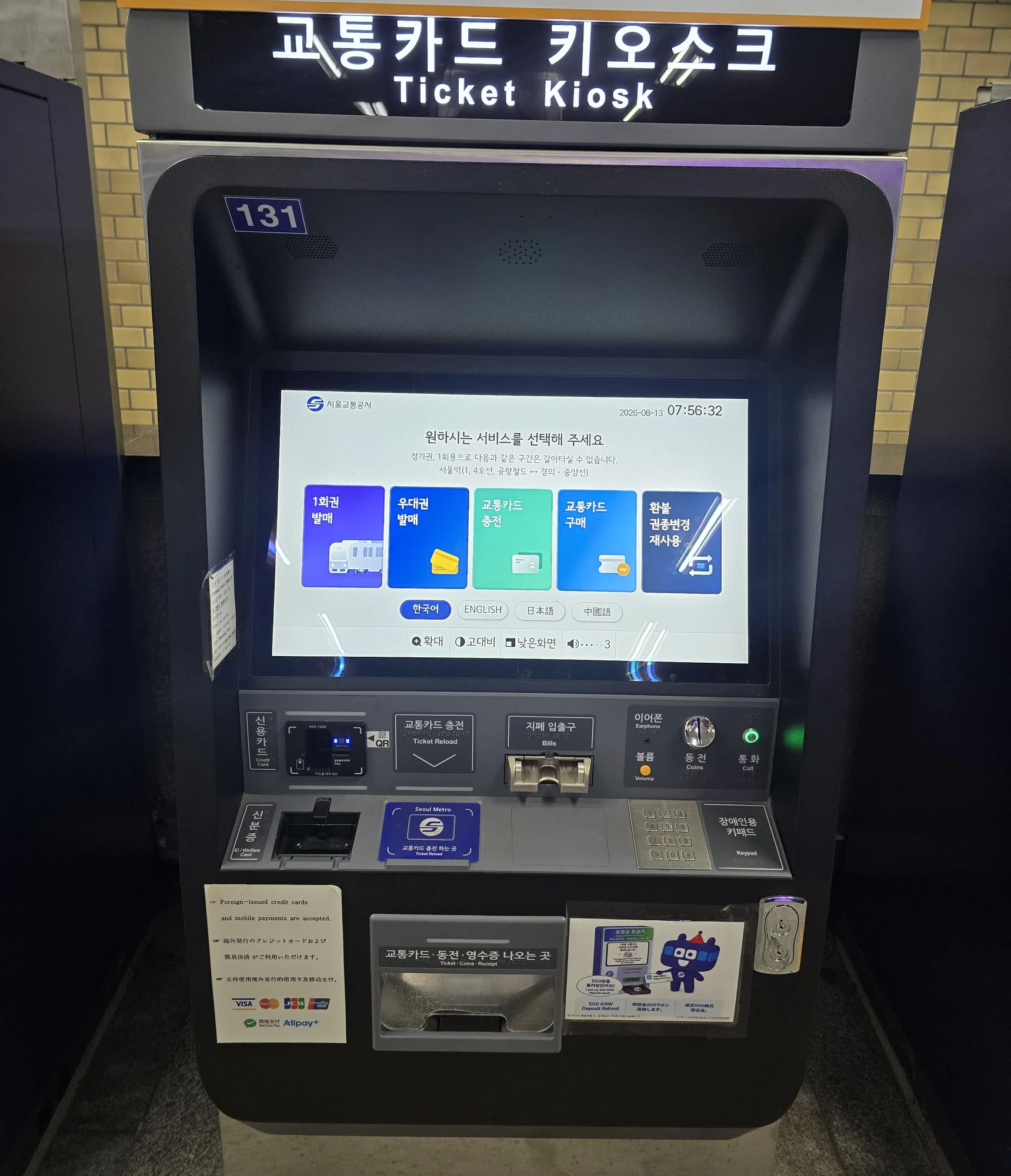
- 2026-08-13 — Replaced the older 2025 Seoul press image with an author-owned current Seoul Metro ticket-kiosk photograph captured that morning and added a current single-journey deposit-refund-machine photo to distinguish it from a Tmoney refund point. The visible kiosk notice states that foreign-issued cards and mobile payments are accepted, but no card, fee, product, approval, refund, or transaction was independently tested.