Official-source checked
The short answer
For a working physical Tmoney card, participating convenience stores refund the full balance in Korean-won cash minus a ₩500 fee: GS25 below ₩20,000, 7-Eleven up to ₩20,000, and CU or emart24 up to ₩30,000. The card purchase price is not returned. Larger balances need a different counter; Tmoney Town has separate fee, identity and bank-transfer rules.
- Korean phone number
- Varies by case
- Foreign-issued card
- Not applicable
- Korean ID
- Varies by case
- English support
- Partial English
In this guide
Your last train ride is over, but your Tmoney still has money on it. For a small balance on a working physical card, a participating convenience store is usually the simplest place to ask for a cash refund. Check the balance first: the store limits differ, and the card’s purchase price is not returned.
This guide covers a normal, readable physical Tmoney card, with station and Tmoney Town options in Seoul. Mobile Tmoney, Climate Card passes and a WOWPASS payment-wallet balance have separate refund procedures.
Choose a counter by your remaining balance
These are the published limits checked on October 30, 2026. Ask the staff whether that branch can process your card before handing it over. A store that sells cards is not a guarantee that every card product can be refunded there.
Swipe or scroll to see all columns.
| Where to ask | Balance or limit | Fee and method |
|---|---|---|
| GS25 | Less than ₩20,000 | Full balance minus ₩500, paid in Korean-won cash |
| 7-Eleven | ₩20,000 or less | Full balance minus ₩500, paid in Korean-won cash |
| CU or emart24 | ₩30,000 or less | Full balance minus ₩500, paid in Korean-won cash |
| Subway station customer information desk | Seoul’s 2026 guidebook lists balances up to ₩50,000 | Ask staff to confirm that desk’s service and the fee; use a staffed counter, not the deposit machine |
| Tmoney Town, near Seoul Station | Up to ₩500,000 per person per day | Separate fee and identity rules; ₩100,000 or more goes to a bank account later |
The convenience-store limits and fees come from Tmoney’s normal-card refund table (Korean). The station ceiling comes from the Seoul government’s 2026 guidebook, PDF page 52. Tmoney’s current detailed table does not list a separate full-refund station row, so confirm the service before relying on a particular station.
Get a convenience-store cash refund
- Finish the journeys you still need. Keep enough balance for your airport trip, or arrange another way to pay. Use the Tmoney top-up calculator to plan remaining journeys; its estimated leftover balance is not a live card reading.
- Bring the card and check its actual balance. Ask staff to read it, or use a compatible top-up machine’s balance display. Choose a store whose limit covers the whole remaining balance.
- Ask for a full balance refund. Say “티머니 잔액 전액 환불해 주세요.” Confirm the cash amount after the ₩500 fee before the refund is processed.
- Check the cash and take your card back. For example, a ₩7,500 balance produces ₩7,000 in cash after that fee. The original price of the card is separate and is not refunded through this normal-card procedure.
At exactly ₩20,000, GS25’s published “less than” limit is not met; 7-Eleven, CU and emart24 have limits that include that amount. A ₩35,000 balance exceeds all three store limits above: ask a station information desk to confirm its service, or contact Tmoney Town. Do not assume a convenience store can simply refund part of it.
Can you take some money out and keep using the card?
Tmoney lists partial refunds for physical cards only at Tmoney Town and subway Tmoney service counters. The requested partial-refund amount must be between ₩10,000 and ₩50,000, in ₩10,000 increments. Ask the counter about the fee and the balance that will remain before proceeding. This is not the convenience-store full-refund service.
If only a small amount remains, compare the refund fee with what you would receive. You can also ask a Tmoney-accepting merchant whether you can use the balance toward a purchase. Confirm split-payment arrangements with that merchant rather than assuming every till supports them.
Larger balances: contact Tmoney Town before your last day
The official foreigner guide places Tmoney Town on the first floor of Seoul City Tower, by Seoul Station Exit 10. For balances over ₩50,000, Tmoney directs normal-card users to its headquarters or an eligible bank ATM.
- Daily limit: Tmoney Town lists up to ₩500,000 per person per day.
- Identity check: requests of ₩50,000 or more require identity details, including name, date of birth and contact information.
- ₩100,000 or more: the balance is deducted on the visit date and transferred to an account after 18:00 on the following business day, excluding weekends and public holidays. The page lists an ID and a copy of the bankbook as documents to bring.
- Town fee: no fee up to a cumulative ₩500,000 per month; the published table lists 1% when that monthly amount is exceeded. This is different from the convenience-store ₩500 fee.
The published page does not settle which foreign identity documents or overseas bank accounts are accepted. Before travelling there with a large balance, ask what documents and account you need, whether cash is available for your amount, and the counter’s opening hours. Tmoney customer service is 1644-0088, weekdays 09:00–18:00; those are support-line hours, not a verified promise of Tmoney Town opening hours. Do not plan a ₩100,000-plus refund as immediate airport spending money.
The ATM route is an account transfer, not an overseas-card cash withdrawal. It requires an account in your own name at a supported bank. Card-product restrictions also apply. An overseas debit card by itself does not establish eligibility; check the operator’s bank and card list.
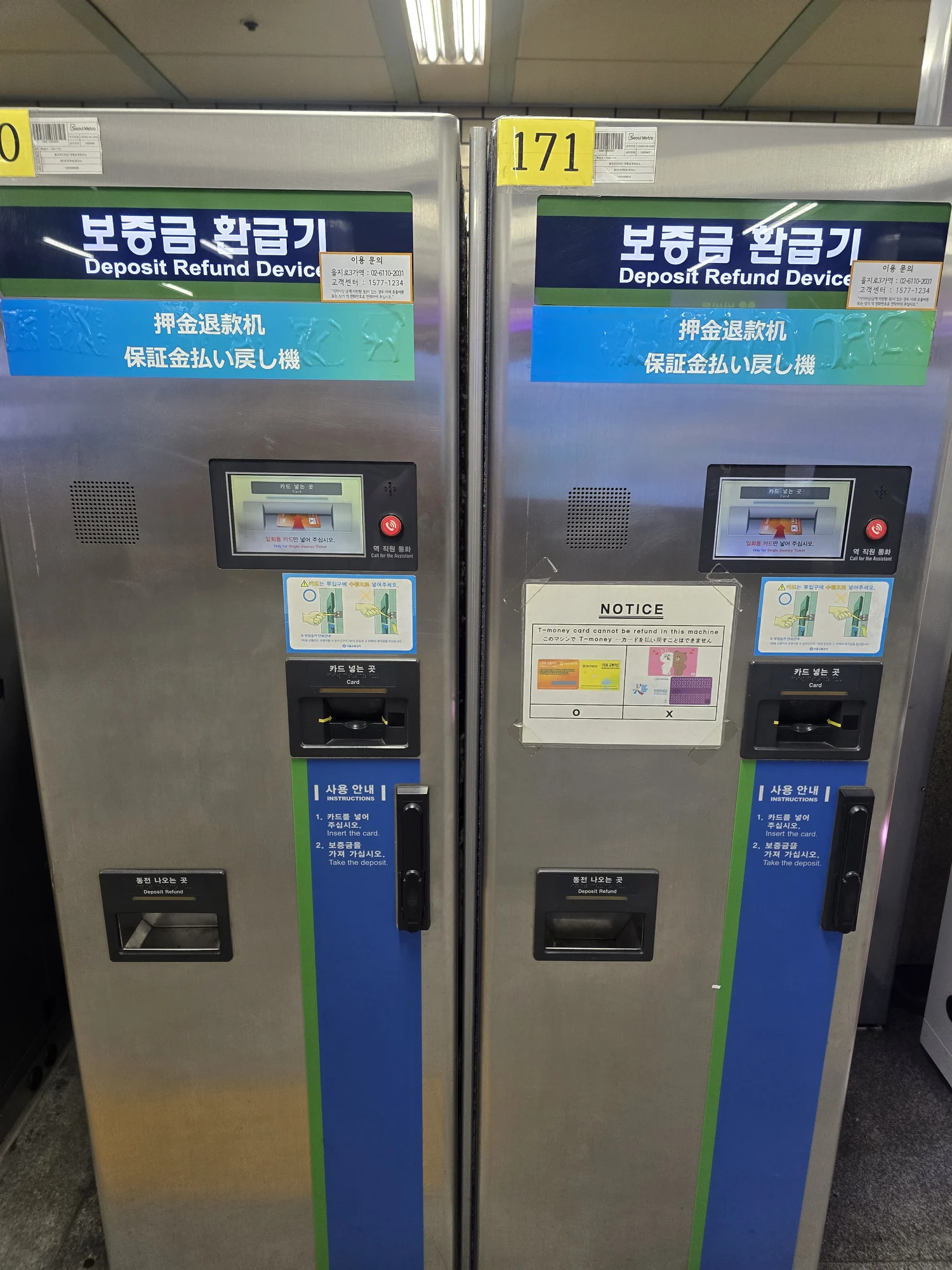
The subway deposit machine cannot refund Tmoney
The machines labelled “Deposit Refund Device” are for eligible single-journey ticket deposits. They do not return a normal Tmoney card’s stored balance. Take Tmoney to a staffed refund counter instead.
If the card cannot be read or the counter refuses
First ask whether the problem is the balance limit, the card product or the card itself. For a faulty or damaged card, use Tmoney’s separate damaged-card refund procedure (Korean). It may involve submitting the card and receiving a later account transfer; the normal-card cash steps above do not establish an immediate refund for an unreadable card. Ask Tmoney which route and documents are available to you before submitting it.
A lost card is not the same as a readable card presented at a counter. This guide does not promise recovery of a lost card’s balance. For a combined travel card, identify whether the money is in its Tmoney transport balance or a separate payment wallet before requesting a refund. Our Tmoney, Climate Card and WOWPASS comparison explains that distinction.
Three phrases to show the staff
- 티머니 잔액 전액 환불해 주세요. — Please refund the full Tmoney balance.
- 수수료를 빼면 얼마를 받나요? — How much will I receive after the fee?
- 이 카드 잔액 환불이 가능한가요? — Can you refund the balance on this card?
Sources and verification
Official information checked October 30, 2026: Tmoney normal-card refunds, Tmoney foreigner guide, damaged-card refunds and the Seoul government guidebook. The detailed operator table takes precedence over the foreigner guide’s general ₩500-fee summary for the Tmoney Town exception. No refund transaction or individual branch service was tested.
Still preparing your card? See buying and topping up Tmoney at Incheon Airport. For your remaining travel budget, return to the Tmoney calculator.
Change log
- 2026-10-30 — Published normal physical-card refund guide after official-source and editorial review. No transaction testing.
Official-source checked Checked
The listed official sources were checked for this version of the guide.
- Next review
- Change rate
- Reviewed every 30 days
- Sources checked
- 4