Official-source checked
The short answer
Look for a Seoul Metro ticket kiosk that visibly offers the single-journey ticket and the payment method you intend to use. Seoul announced that 440 new machines at 273 stations on Lines 1–8 began accepting internationally issued credit and debit cards for single-journey tickets on March 17, 2026. The city states that international-card purchases carry an average service fee of approximately 3.7 percent.
Choose English, select Single Journey Ticket, find the exact destination station, confirm the fare and quantity, and keep the card until the trip is finished. Tap it at the entry and exit gates. After exiting, insert the single-journey card into a Deposit Refund Device to recover the KRW 500 deposit. That refund machine is not a general Tmoney refund point.
A foreign-card logo or city announcement creates an acceptance route, not guaranteed approval. If the machine, product, network or issuing bank rejects the payment, use another designated machine, ask station staff, use Korean-won cash where accepted, or switch to a reusable transport card.
For repeated rides, compare Tmoney, Climate Card and WOWPASS. If a payment is declined twice, stop and use the foreign-card recovery Guide.
- Korean phone number
- Not required
- Foreign-issued card
- Partially supported
- Korean ID
- Not required
- English support
- Partial English
In this guide
Compatibility details and limits
Swipe or scroll to see all columns.
| Requirement | Current boundary | What to do |
|---|---|---|
| Korean phone number | Not required for the physical single-journey ticket | Do not enter personal phone data into an unfamiliar machine |
| Foreign-issued card | Supported only at designated compatible machines and still issuer-dependent | Read the payment labels on the live machine before starting |
| Korean ID | Not required for a normal adult single-journey ticket | Use the correct age or discount product only when eligible |
| English support | Available on many current kiosks, but wording can vary | Select English first and ask staff if the product is unclear |
| Reusable on buses | No | A single-journey subway ticket is not a bus card |
Decide whether this is the right product
Use a single-journey ticket when you need one subway ride, cannot obtain or load a reusable card yet, or want a simple fallback after another fare product fails. It is less convenient for a day of repeated trips because every journey requires a new purchase and a separate deposit return.
Do not confuse it with standard Tmoney, a Climate Card pass, an AREX Express ticket or a KTX ticket. Those products have different purchase, loading, route and refund rules. A Seoul subway machine may display several product buttons, and international-card support may apply to only some of them.
If you arrived at Incheon Airport and plan several local rides, first read where to buy and top up Tmoney at Incheon Airport. If you are choosing between airport train, bus and taxi, use the Incheon Airport to Seoul Guide before buying a city ticket.
Before touching the machine
Save the destination’s Korean name and exact station name in your map app. Seoul has repeated neighborhood names and stations with similar English spellings. Confirm the line number and the direction after finding the destination; the machine selects a fare destination, but it does not prevent you from entering the wrong platform.
Have a second payment method and modest Korean-won cash available. Keep the foreign card in sight, shield the PIN if requested, and do not accept help from a stranger who asks to handle the card or phone. The safe help route is the staffed station office or call button on the official machine.
Use NAVER Map in English to save the station and exit before you go underground. A screenshot of the Korean destination and exit number is more useful than a district name alone.
Step 1 — Identify a compatible kiosk
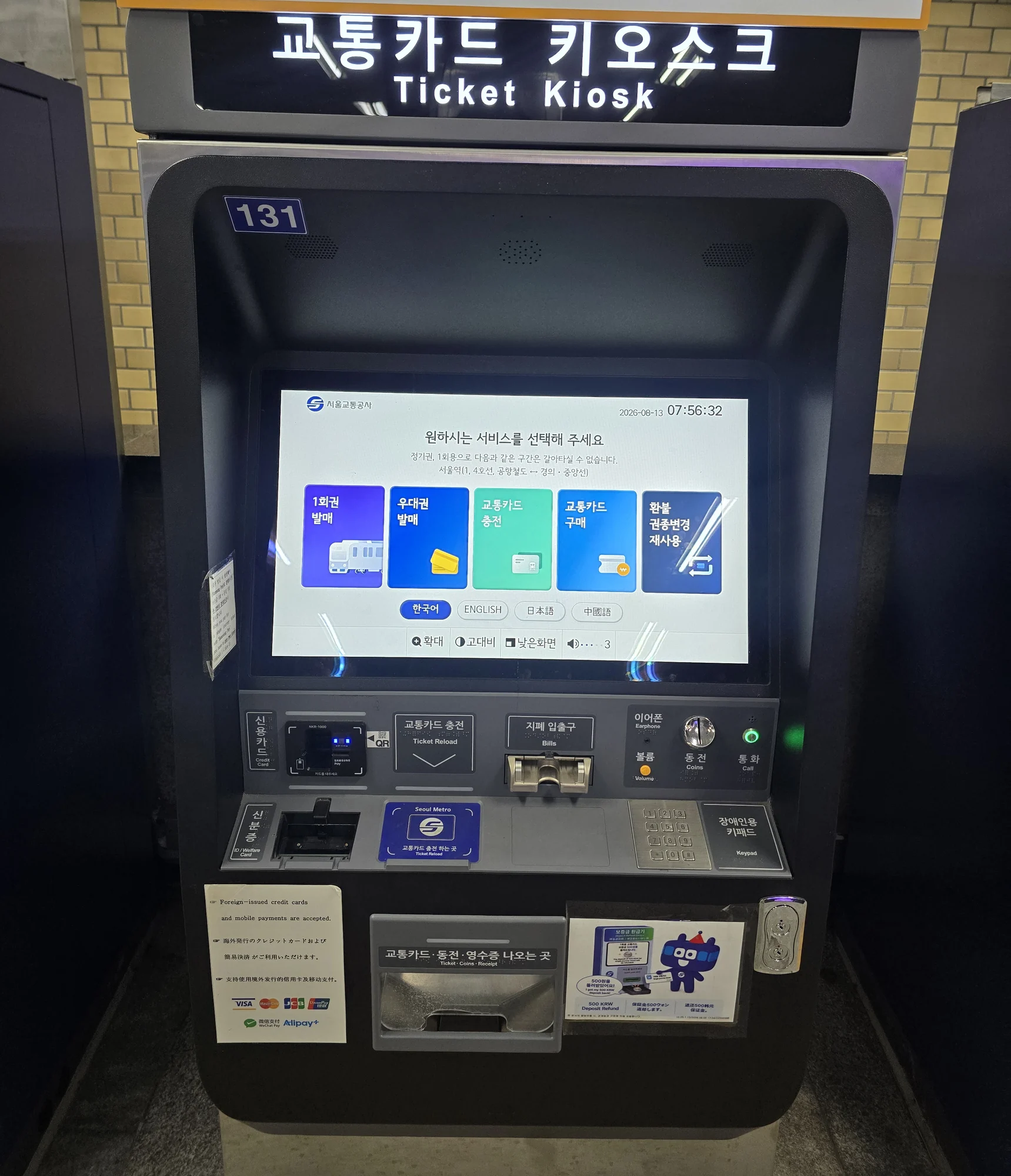
Find a machine labelled for ticket vending rather than a balance adjustment or deposit refund. The current photographed Seoul Metro kiosk has buttons for single-journey ticket purchase, discounted ticket purchase, transit-card recharge, transit-card purchase, and refund or receipt functions. Another machine may expose fewer options.
Before selecting a product, look for a posted notice or screen instruction that explicitly includes internationally issued cards or the relevant card network. The 2026 city rollout covers designated new machines on Lines 1–8; do not assume that every machine operated by every metropolitan rail company has the same hardware or fee.
If the only nearby machine does not show your payment method, do not repeatedly insert the card. Move to another clearly compatible kiosk or ask station staff which machine sells a single-journey ticket with a foreign card.
Step 2 — Select English and the exact destination
Choose the English language control before starting. Select the single-journey ticket, not transport-card recharge. Search for the destination by English station name or line, then compare the station number with the route saved on your phone.
Check whether the route requires a transfer. A normal subway transfer inside the paid area remains part of the same trip when you follow the transfer signs. Exiting through a gate and entering another station can create a new fare unless the specific transfer arrangement says otherwise.
Review the adult, teen or child selection carefully. Do not choose a discounted product merely because it is cheaper. Eligibility and proof rules apply, and the machine’s language may distinguish ordinary, child and concession tickets differently.
Step 3 — Review the amount before paying
The total can contain the distance-based fare, the single-journey price difference and the refundable KRW 500 card deposit. The Seoul public-transport page currently says single-journey tickets cost KRW 100 more than the corresponding regular transport-card fare. The final live machine amount controls because fares and policies can change.
For an international-card transaction, the Seoul announcement states an average service fee of approximately 3.7 percent. Read the displayed total and any currency choice. If dynamic currency conversion appears, do not let another person choose for you; compare the KRW option with your issuer’s terms.
Allow one clean retry only after the first transaction fully cancels. If a second attempt fails, move to the fallback ladder instead of generating several pending authorizations.
Step 4 — Take every item the machine returns
Collect the ticket, bank card, receipt and change before leaving. Count the physical items rather than trusting the completion screen. Keep the receipt until the issuer app shows the correct transaction and the trip is finished.
Do not photograph or publish the full bank card, receipt reference, authorization code or PIN screen. If you need help, record the station, machine number, time and error message without exposing account data.
Step 5 — Tap in, follow the platform signs and tap out
Place the single-journey card flat on the marked gate reader. Wait for the gate response before moving. If the gate rejects it, step aside so other passengers can pass and use the staffed gate or help button; forcing through can turn a simple ticket problem into a fare dispute.
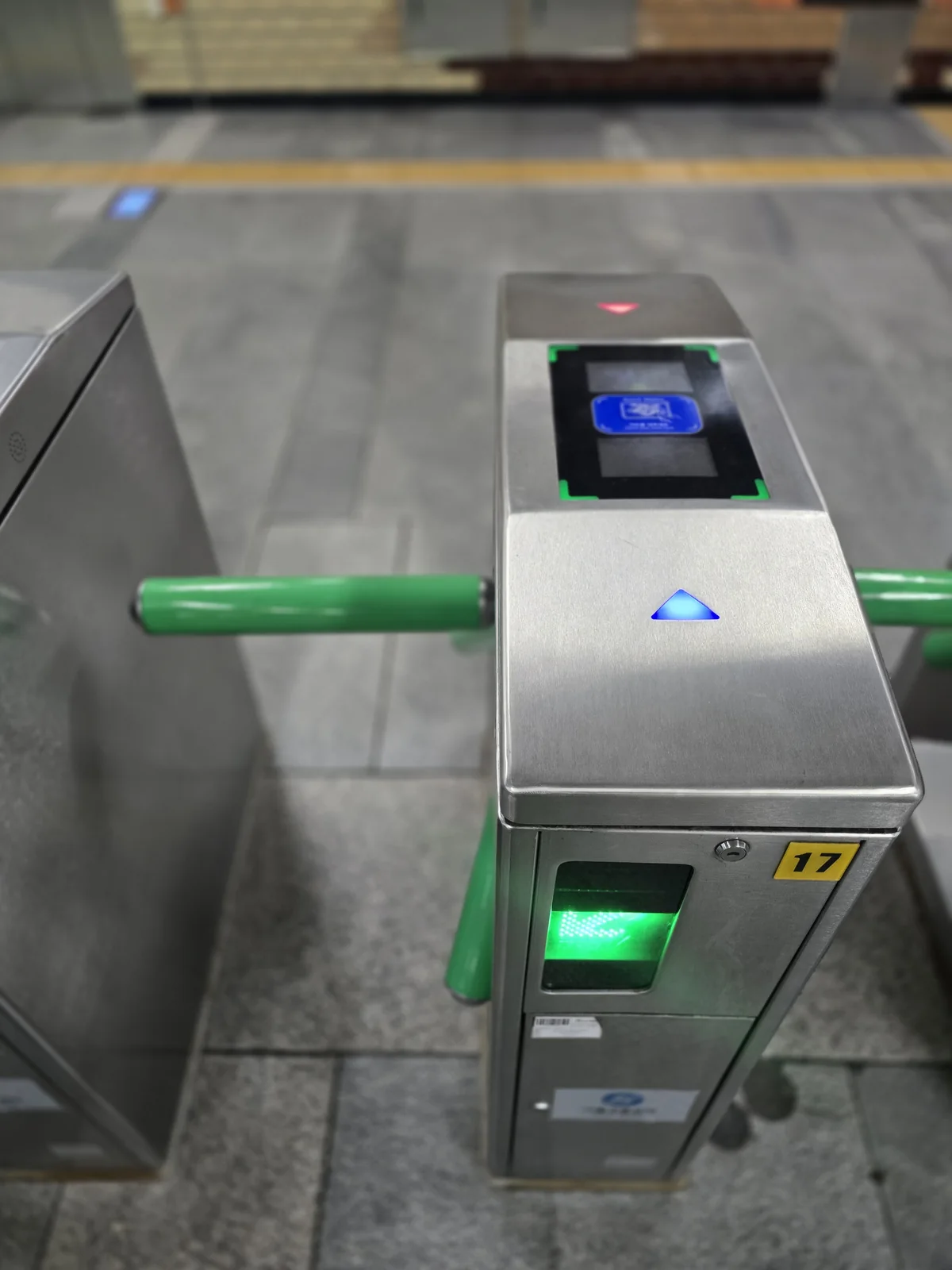
On the platform, match three things: line, direction or terminal station, and the next station. Follow transfer signs inside the paid area. At the destination, tap the same ticket at the exit gate and keep it after the gate opens.
If the balance is insufficient because the journey changed or the exit calculation differs, use the official fare-adjustment machine or staffed office. Do not buy a second ticket while still inside the paid area without staff guidance.
Step 6 — Recover the KRW 500 deposit
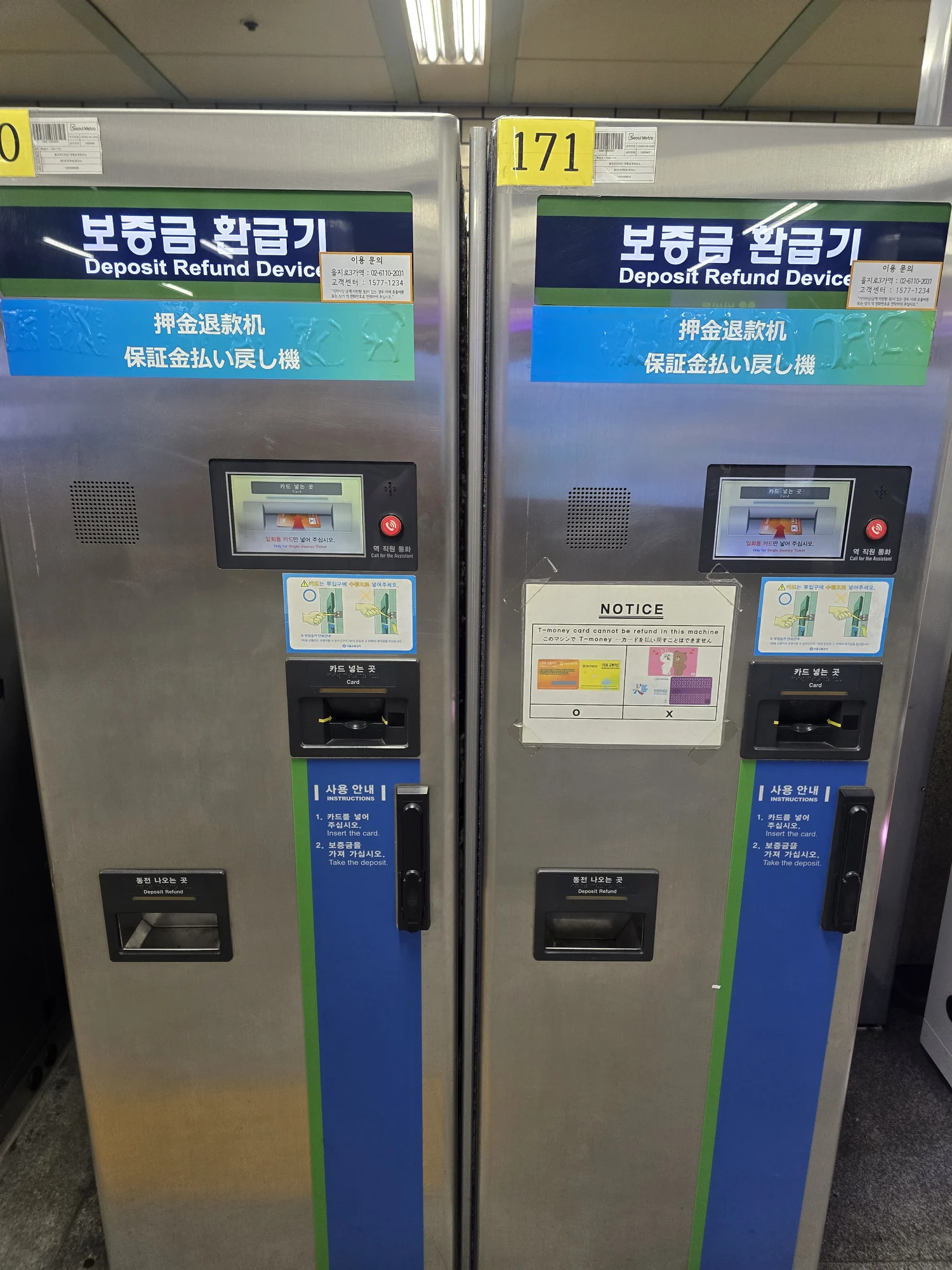
After leaving the paid area, find a machine labelled Deposit Refund Device. Insert the eligible single-journey card in the marked slot and take the returned KRW 500. The current photographed machines explicitly warn that Tmoney cannot be refunded there.
A reusable transport-card balance and physical-card cost follow different refund rules. Never insert a bank card, Tmoney card or unrelated pass into the single-journey deposit machine because it looks like a refund device.
If something goes wrong
Swipe or scroll to see all columns.
| Problem | Likely boundary | Safest next action |
|---|---|---|
| No foreign-card option appears | Older or unsupported machine, operator or product | Find a designated compatible kiosk or ask station staff |
| Card is declined | Issuer, network, terminal, amount or authentication issue | Allow one clean retry, then switch method and check the issuer app |
| Wrong destination was selected | Similar station name or line | Stop before entering and ask staff whether cancellation or adjustment is possible |
| Gate rejects the ticket | Wrong gate, incomplete purchase, damaged card or fare issue | Use the staffed gate; do not force through |
| Exit says insufficient fare | Route or distance changed | Use the fare-adjustment machine or staffed office |
| Deposit machine rejects the card | Wrong machine, ineligible card or card not properly exited | Confirm it is a single-journey ticket and ask staff |
| Duplicate pending card charges appear | A failed authorization may still be pending | Keep receipts and contact the issuer through its official channel |
Useful Korean phrases
1회용 교통카드를 사고 싶어요.— I would like to buy a single-journey transit ticket.해외 발급 카드가 되는 기계가 어디예요?— Which machine accepts foreign-issued cards?이 역으로 가는 표가 맞나요?— Is this the correct ticket for this station?개찰구에서 카드가 안 돼요.— The card does not work at the gate.보증금 환급기는 어디예요?— Where is the deposit refund machine?
Frequently asked questions
Can every Seoul subway machine take a foreign card?
No. The city’s 2026 announcement describes designated new machines on Lines 1–8. Read the actual machine and product payment labels.
Can I use the single-journey ticket on a bus?
No. The official Seoul overview says it is for the subway only. Use a supported transport card or another currently accepted bus payment method.
Is the KRW 500 part of the fare?
It is a refundable deposit for the physical single-journey card. Return the eligible card at the dedicated deposit-refund machine after exiting.
Can the refund machine return my Tmoney balance?
No. The photographed deposit machine explicitly says Tmoney cannot be refunded there. Follow the current Tmoney refund route instead.
Official-source review — October 5, 2026
Rechecked the published practical claims against the following current primary sources. This is an official-source review, not a completed transaction or journey.
440 machines/273 stations on Lines 1–8; average approximately 3.7% fee; KRW 100 fare difference and KRW 500 refundable deposit; subway-only scope
english.seoul.go.kr · english.seoul.go.kr · english.visitseoul.net · pay.tmoney.co.kr
No purchase, activation, account verification, withdrawal, payment, booking, ride or on-site journey was performed in this review. Existing screenshots keep their original dates and limitations. Live operator and issuer rules control; individual success remains unverified.
Official sources
- Seoul Metropolitan Government: international cards for Climate and single-journey tickets — March 17, 2026 rollout, designated-machine count, supported products and average service fee; checked September 2, 2026.
- Seoul Metropolitan Government: Public Transportation — single-journey kiosk, KRW 500 deposit, subway-only boundary and refund sequence; checked September 2, 2026.
- Visit Seoul: Transportation — current visitor-facing subway entry, transfer and refund overview; checked September 2, 2026.
- Tmoney foreign-language guide — reusable-card scope and loading boundary; checked September 2, 2026.
Change log
- 2026-10-06 — Simplified repeated review text and/or added task guidance and clearly labeled calculation examples. Original evidence dates, verification status and test limits are unchanged.
- 2026-10-05 — Rechecked current primary-source practical conditions and recovery limits. No transaction or journey was field-tested.
- 2026-09-10 — Added contextual photographs and instructional screenshots with source and privacy notes. This media update does not change the information-verification date or field-test status.
- 2026-09-02 — Check which Seoul ticket machines accept foreign cards, how to buy a single-journey ticket and where to recover its deposit.
- 2026-09-02 — Verification scope: No card transaction, ticket purchase, fare adjustment, gate passage, ride or deposit refund was independently tested for this Guide.
Official-source checked Checked
The listed official sources were checked for this version of the guide.
Official-source review: October 5, 2026. No transaction or journey was tested. See the detailed review and sources below.
- Next review
- Change rate
- Reviewed every 30 days
- Sources checked
- 4